History

The Sentinel of Safety: A Historical Account of Pusat Racun Negara
PRN has been a steadfast guardian of public health for over three decades. What began as a research initiative at Universiti Sains Malaysia (USM) in 1982, the Integrated Drug & Poison Information Service (IDPIS), quickly evolved into a national institution and an international authority in toxicology and poison prevention.
Genesis of a National Imperative (1982-1996)
The journey began in 1982 with the establishment of IDPIS by USM, marking Malaysia's first structured effort for drug and poison information. By 1988, IDPIS had expanded nationally, integrating into TELEKOM MALAYSIA's TELITA system. The vision for a national poison centre gained momentum, with the Minister of Education announcing its establishment at USM in 1993. This vision became a reality when the Malaysian Cabinet approved PRN's establishment in 1994, designating it as the sole national poison centre.
PRN officially began operations in 1995 with Professor Emeritus Tan Sri Dato' Dzulkifli Abdul Razak appointed as the Founding Director. Its initial mandate included providing Drug and Poison Information Services and spearheading a Poison Prevention and Education Unit. The centre was formally inaugurated in 1996. PRN rapidly expanded its capabilities, adding a Research and Documentation unit and a Toxicology Laboratory. Demonstrating an early commitment to public outreach, PRN also launched its website and newsletters that same year.
Consolidation, Recognition, and Expanding Influence (1997-2004)
The late 1990s and early 2000s were a period of significant consolidation and recognition for PRN. In 1997, the Malaysia Book of Records recognized PRN as the premier poison centre in the nation. PRN actively initiated public health efforts, including crucial childhood lead poisoning studies. Their advocacy directly led to mandatory fluoride labeling in children's toothpaste, a testament to their impact on public safety.
International recognition swiftly followed. In 1999, PRN proudly became a WHO Collaborating Centre for Drug Information and an Executive Member of the International Society of Drug Bulletins (ISDB). Domestically, PRN's excellence was acknowledged with the USM Inaugural Quality Award (Service Section). They also pioneered Malaysia's first Smoke-Free Club, Kelab Nafas Baru.
Professor Dr. Rahmat Awang took the helm as the second Director in 2001. Under his leadership, PRN launched an e-learning module for pharmacoinformatics and received the Anti-Tobacco Initiative Award from the Ministry of Health. The Clearinghouse for Tobacco Control (C-Tob) was established in 2001, supported by funding from the Rockefeller Foundation. PRN hosted the 3rd International Congress of the Asia Pacific Association of Medical Toxicology (APAMT) in Penang.
A major public health victory occurred in 2003: PRN's collaboration with the Department of Agriculture led to a ban on paraquat, a highly toxic pesticide, which was fully phased out by 2005. The Drug & Poison Information unit also initiated a vital 24-hour Poisoning Emergency Hotline. By 2004, PRN continued to innovate, establishing an ICT and Multimedia Unit and developing hazardous chemical toolkits for schools in collaboration with WHO-IPCS.
Broadening Horizons and Educational Innovation (2005-2015)
From the mid-2000s, PRN significantly increased its focus on community health promotion and innovative educational tools. In 2005, it launched its first Community Health Promotion Program on Chemical Safety in Lahar Kepar, Penang. The HelpLine and QuitLine were introduced in 2006, expanding vital smoking cessation support.
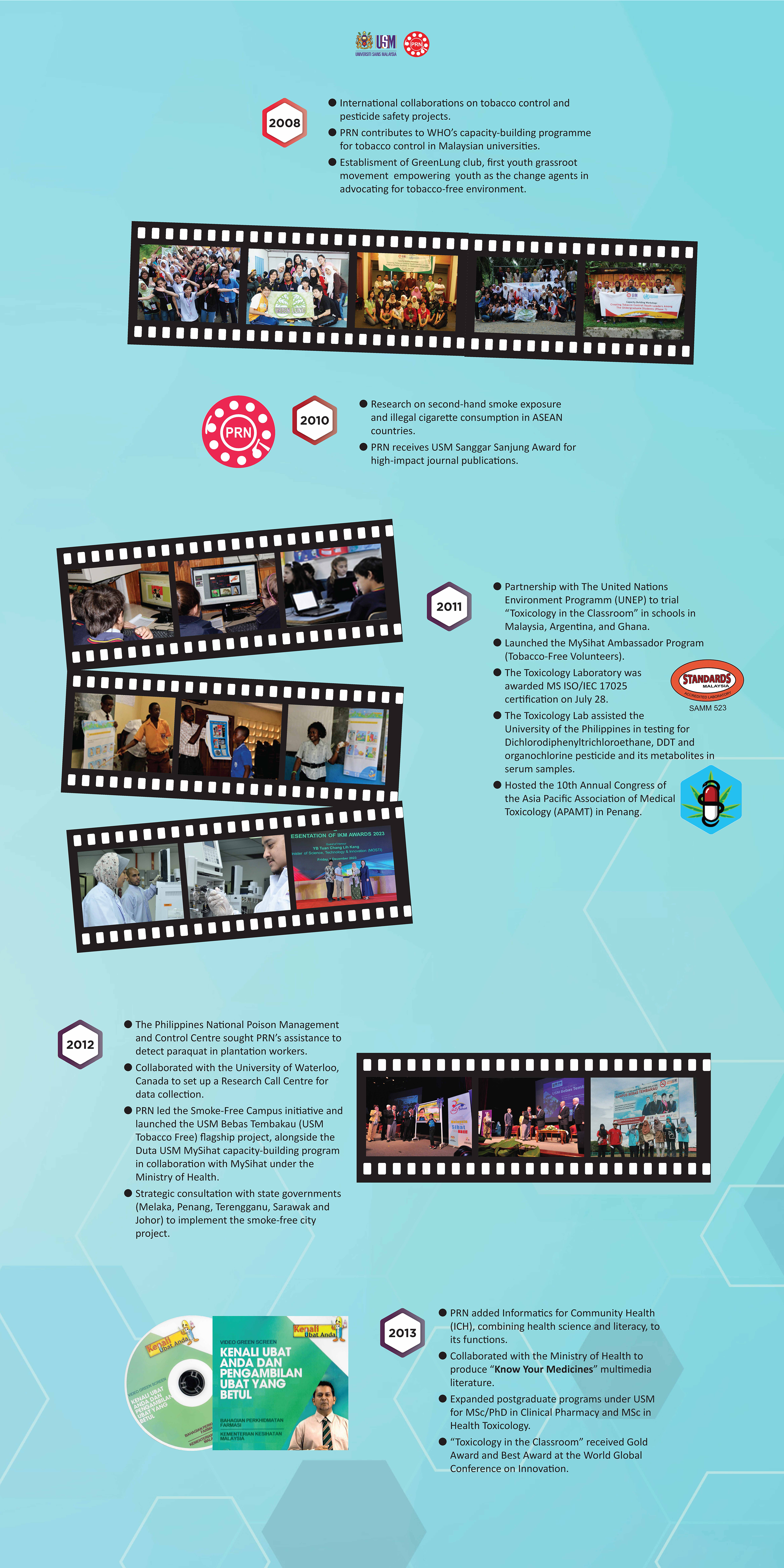
Associate Professor Razak Lajis became director in 2007. During his tenure, PRN collaborated with WHO-IPCS to develop "Toxicology in the Classroom", a program later tested in Malaysia, Argentina, and Ghana. A significant milestone for the Toxicology Laboratory came in July 2010 when it achieved MS ISO/IEC 17025 certification.
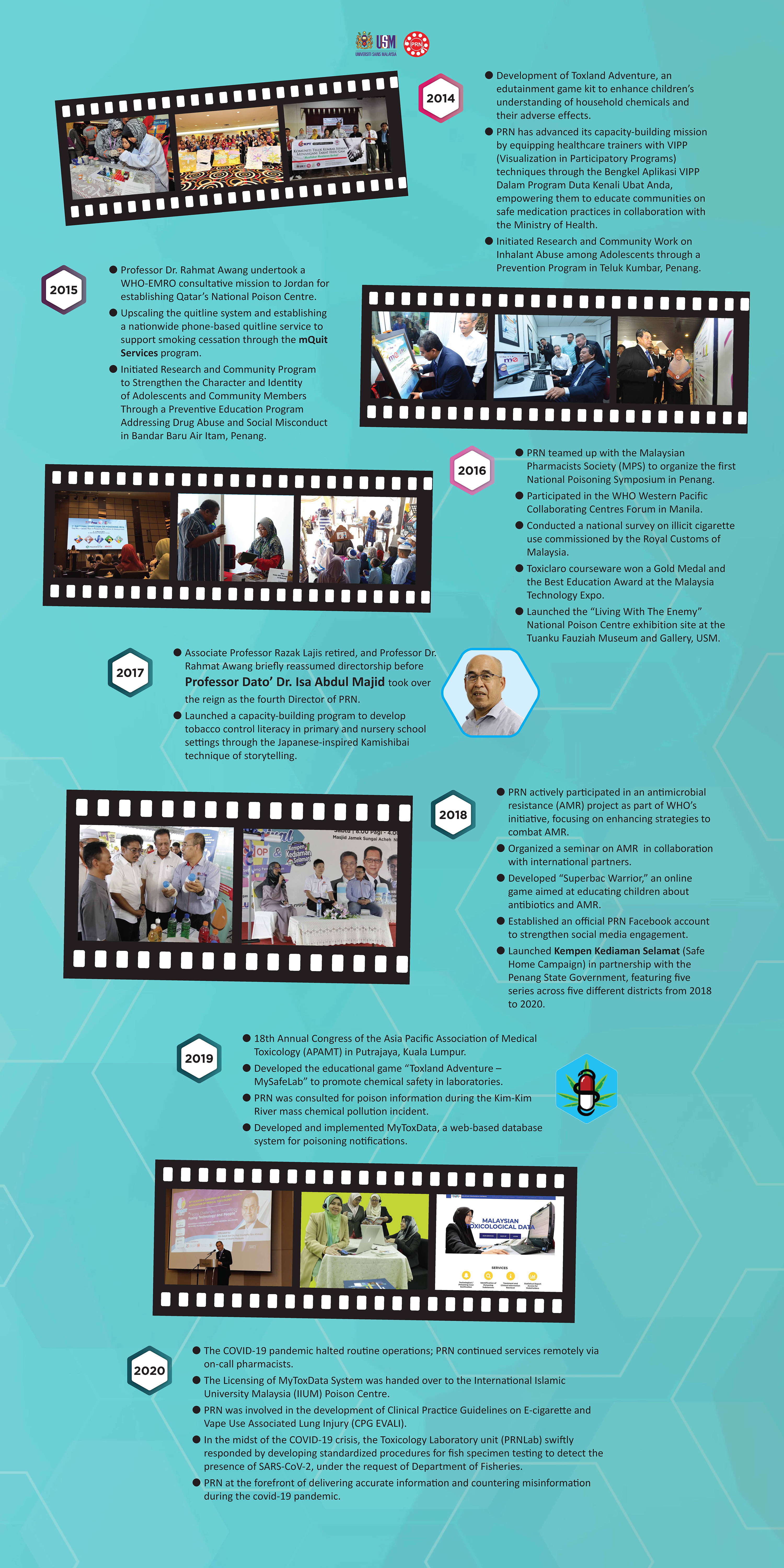
PRN once again hosted the APAMT Annual Congress in Penang in 2011. 2012 proved to be a dynamic year, with the Toxicology Lab assisting the University of the Philippines with DDT and organochlorine pesticide testing. In 2013, PRN expanded its scope to include Informatics for Community Health (ICH). "Toxicology in the Classroom" garnered well-deserved recognition, winning Gold and Best Awards at the World Global Conference on Innovation. Furthering its commitment to engaging educational tools, "Toxland Adventure", an edutainment game kit for children, was developed in 2014. In 2015, Professor Dr. Rahmat Awang undertook a WHO-EMRO consultative mission to Jordan, assisting in the establishment of Qatar's National Poison Centre.
Modern Leadership, Resilience, and Digital Transformation (2016-Present)
From 2016 onwards, PRN has focused on innovation, resilience, and digital transformation. The Toxicology Laboratory has consistently received the Institute Kimia Malaysia (IKM) Excellence Laboratory Award from 2016 to 2024. Professor Dato' Dr. Isa Abdul Majid became the fourth Director in 2017. In 2018, PRN actively engaged in the global fight against antimicrobial resistance (AMR), developing "Superbac Warrior," an online game designed to educate children on antibiotics and AMR. PRN also embraced digital outreach, launching an official Facebook account and the "Kempen Kediaman Selamat," a home safety program implemented across five districts in Penang.
In 2019, the USM Senate recognized PRN as a Centre of Excellence (CoE) in Services. PRN's expertise proved vital during the Kim-Kim River mass chemical pollution incident in Johor. Further enhancing its capabilities, MyToxData, a web-based database system for poisoning notifications, was developed. That same year, PRN once again hosted the APAMT Annual Congress, this time in Putrajaya.
The COVID-19 pandemic in 2020 presented unprecedented challenges. PRN demonstrated remarkable adaptability, continuing to provide services remotely. It played a crucial role in countering misinformation. Associate Professor Dr. Balamurugan Tangiisuran served as the fifth director in 2021. This year also marked the initiation of National Poisoning Prevention Month and the launch of PRN's first microcredential course, the Drug & Poison Information Services (DPIS) Course.
In 2022, Dr. Nur Azzalia Kamaruzaman became the sixth director. 2023 saw "SuperBac Warrior" evolve into "GErMiE," a mobile game app focused on hygiene and AMR education, earning multiple Gold Awards. PRN received a WHO grant for research on ENDS/ENNDS and actively supported the Malaysian government's ban on chlorpyrifos and carbofuran in agriculture. A significant technological leap in 2023 was the integration of Voice Over Internet Protocol (VoIP) into the DPIS telecommunication system, establishing a single, round-the-clock contact number (04-6536 999).
PRN's influence continued into 2024, marked by a Gold Medal at the IUCEL X kNovasi 2024 Awards. PRN also proudly hosted the 22nd APAMT Annual Congress in Penang.
For over three decades, Pusat Racun Negara has been a vigilant sentinel of public health in Malaysia. It has grown into a multifaceted institution offering emergency response, laboratory analysis, research, and public education. PRN's innovation, strategic partnerships, and unwavering commitment to poison prevention have saved countless lives and profoundly shaped public health policy and awareness in Malaysia and beyond. Its rich history stands as a testament to the enduring impact of specialized expertise dedicated to a nation's well-being.